
This holiday of Pesah, as we know, is all about evoking memory and constructing identity – especially when we consider the rituals of the seder. On those first nights of the holiday, we recount the Exodus from Egypt, adding our own questions and interpretations to the chain of tradition that stretches thousands of years behind us. We endeavor to see ourselves as though we personally left Egypt, forming a deep-seated sense of connection to our biblical ancestors and understanding who we are in relation to them.
But the seder, and in fact the entire experience of Pesah, evoke another sort of memory. Rather than simply immersing us in collective memory, our holiday celebrations often call forth our own memories of Pesah celebrations past.
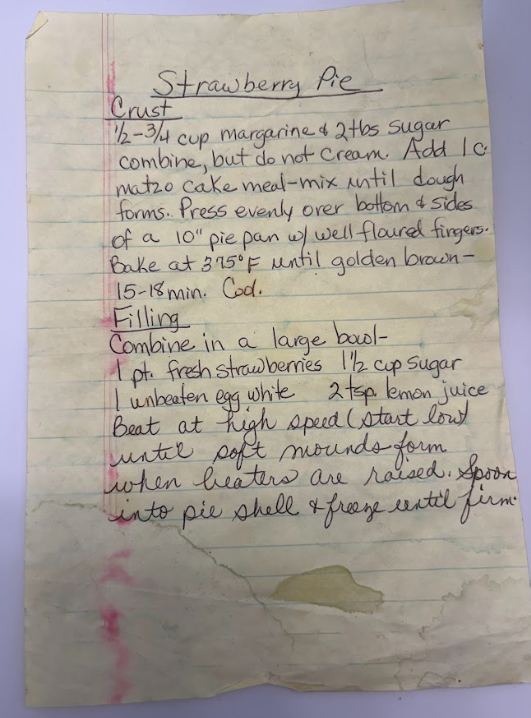
At my first seder this year, while the kids were still looking for the Afikoman, my uncle took a bite of the slice of strawberry pie that was on his plate. He turned to me and said, “This is your mom’s recipe, right? I’m tasting it and it’s taking me back to seders with her, at your parents’ house. I can almost see her sitting across from me.”
The next evening, Shmuel reflected something similar as he was noshing on some mandel bread, which he knows as Grandma’s mandel bread . He commented how interesting it was that we only eat Pesah foods and do Pesah things once or twice a year, but we remember them as clearly as if they were frequent parts of our daily lives.
This is the paradox of Pesah: it’s only 8 days long and many of its defining experiences are quite brief, but these experiences imprint themselves on us more powerfully than things we repeat all year. And it is also one of Pesah’s miracles: one small taste can contain the essence of an entire person.
The ways that memories pop up for us during Pesah are baked into the Torah’s vision for the holiday itself. In the book of Shemot, as the Israelites are beginning to leave Egypt, the first thing Moshe says to the people is: “Remember this day, on which you went free from Egypt, the house of bondage, how GOD freed you from it with a mighty hand.” (Exodus 13:3) Rashi takes the instruction to remember several steps further. He comments: “Learn from this that one must mention the Exodus from Egypt every single day.” (Rashi, Exodus 13:3) The experience of celebrating Pesah isn’t only about remembering what happened, it’s about ensuring that we carry it with us and keep it fresh in our minds –
And in our mouths, and our eyes, and our noses. At the seder, we use all of our senses to embody the experience of leaving Egypt, of putting ourselves firmly in the shoes of b’nei yisrael. We don’t just talk about the difficulties of being enslaved to Pharaoh; we eat the bread of affliction. We don’t simply describe the bitterness of the Israelites’ experience; we taste both its sharp pungency and its sorrowful tears. We don’t only imagine the potential growth and development that come from being freed; we see it in the green of the vegetables we eat for karpas. All of these experiences and rituals, small though each one is, become a richly layered tapestry of emotional memory, forming a sort of time warp that jumps from Pesah to Pesah, creating a bridge between past and present. These moments become anchors, rooting us to our past Pesah celebrations and to the people who took part in them.
We often hear the phrase: “You are what you eat.” And the foods we eat on Pesah tell us a great deal about who we are. However, we might instead say it otherwise: We are what we remember. Yizkor, which we will turn to shortly, might seem like a deviation from our holiday celebrations - a pause in the joyful gatherings that mark these days. And in some sense, it is that. We mark the conclusions of our holidays by taking time to embrace the experience of grief, to remember those we’ve lost, to feel the reality of their absence.
Absence, however, is not erasure. In this way, Yizkor is the fulfillment of our holiday celebrations. If the magic of Pesah lies in its ability to carry our long ago into our now, then Yizkor is the most personal dimension of that magic. Those whom we remember today are physically gone from our world, but they are not gone from our lives. They remain with us through the ways they shaped our personalities and our seder tables, our worldviews and our favorite recipes.
This is the paradox of Yizkor: they are gone, but they are very much here. And it is also one of the miracles of Yizkor: We give them life beyond life by repeating rituals and recipes that somehow embody the entirety of who they were, enabling us to carry them with us always.
And even when some of the memories contained in our cerebral selves begin to blur, our bodies remember. We taste them and are transported. Yizkor, especially this Yizkor that we recite at the end of Pesah, gives voice to our multifaceted capacity for memory, reminding us that our physical experiences become inscribed on our souls, that we hold parts of those we have lost inside ourselves.
When my uncle tasted the strawberry pie, he instantly remembered his sister. Time telescoped into itself and he saw her as she once was, bringing her back into the present. Even though Shmuel doesn’t really have any independent awareness of the mandel bread being my mother’s, the same thing happened for him. He was transported into memories of his grandmother, something he never fully lived, but which he owns just as powerfully as if he had. Even though he didn’t know her for long enough, even though he couldn’t picture every detail, he felt her presence.
We come to say Yizkor both because of those we have lost and because of how we still hold onto them. Just as the seder is a yearly touchpoint of repeated rituals, strengthening the framework of who we are, Yizkor is a recurring opportunity to recall the things that our loved ones left us with – both the sweetness and the bitterness – and to remember that they will never fully disappear.
As we prepare to turn to our Yizkor prayers, I invite you to think of your own “strawberry pie moment,” a taste, a holiday tradition, a phrase they used to say, a song they loved to sing – something small that somehow captures the essence of an entire person. May those memories call forth their presence even as we recall their loss, and may their presence and our memories of them remain an eternal blessing.